Zum Inhalt springen
English Version of the exhibition
ABORTION
No reason to be ashamed. Many reasons to talk.

Abortions are a part of many people's lives. Nevertheless, people often don't talk openly about them.
Welcome to this exhibition! This exhibition is a project by raum:kollektiv*. It presents a selection of thoughts, information, and experiences on the topic of abortion—and it is by no means finished or complete. And that’s a good thing! The topic of abortion is incredibly diverse and multifaceted. We’d love for you to just walk in, look around, and bring your own perspective with you. We are raum:kollktiv*: a FLINTA* construction collective from Leipzig. We combine political and social issues with craftsmanship. In public spaces, FLINTA* perspectives have rarely been taken into account—until now. We want to change that. We build and design spaces where these perspectives become visible and can be experienced—spaces for connection, exchange, and new perspectives. Our collective is an open group. We learn from and with one another, work together, and combine craftsmanship with meaningful content. Our work is shaped by the people who contribute, the places where we work, and the issues that matter to us. Our stance: an intersectional perspective on abortion. Intersectional = People are often disadvantaged in multiple ways at the same time, e.g., because they are women, have a disability, or belong to a certain religion.
Language Note: We use gender-inclusive language. You will see words like “doctors*.” We are referring to women, men, and people who do not identify as either women or men. This means we are referring to all people. No one should be excluded. Language Note: FLINTA stands for women, lesbians, intersex people, non-binary people, transgender people, and agender people. FLINTA* is a term for people who face discrimination based on their sex or gender identity (within the patriarchal system). FLINTA* is often used when discussing access to certain safe spaces. The asterisk refers to people who are non-cisgender men and do not identify with any of the categories listed. (0)
What does the exhibition display? -The steps to an abortion -The abortion laws in Germany -History and protest -Medical Basics -International comparison -Barriers to excess abortions
In addition, people share their own stories about their abortions. You’ll find these stories in the second part of our exhibition. You can explore the exhibition at your own pace. You can skip content or take a break.
Here's what it's all about: Every person should be able to make their own decisions about their pregnancy. Abortions must be legal. Abortions must be safe and affordable. Abortions must be accessible to everyone.
On “Safe Abortion Day,” people around the world are fighting for safe and legal abortions. “Safe Abortion Day” refers to safe abortions. It takes place every year on September 28. This day of action originated in feminist movements in South and Central America and the Caribbean (1). The World Health Organization also participates in this day of action. It considers safe abortion to be an important part of health care. (2) Abortion as a Criminal Offense in Germany Abortion is generally a criminal offense in Germany. It is covered by the Criminal Code. Under certain conditions, however, it is not punishable. (3)
105,710 abortions were reported in Germany in 2025. (4) 69% …of the individuals were between the ages of 18 and 34 at the time of the procedure. (5) 74% …believe it is acceptable to be able to terminate a pregnancy during the first twelve weeks without restriction. (6)
Are you looking for counseling or support? Everyone has the right to counseling. General pregnancy counseling is free of charge and can be provided anonymously upon request. (7)
Find accredited counseling centers: BIÖG (Nationwide Search for Counseling Centers)
familienplanung.de/beratung/beratungsstelle-finden The database contains more than 1,500 counseling centers. You can filter the results to see which centers issue counseling certificates (see Plan 2: The Path to an Abortion).
Inclusion on the list is voluntary. Therefore, it is not exhaustive. The legal basis for the list is § 13(5) of the Swiss Debt Enforcement and Bankruptcy Act (SchKG). (8)
“Pregnant Women in Need” Helpline 0800 40 40 020 The helpline is free, anonymous, and available 24 hours a day. (9)
The Steps to an Abortion
In Germany, there are three legal avenues for terminating a pregnancy: 1. the counseling requirement 2. medical indication 3. criminal indication Different rules apply to each avenue.
The Counseling Requirement In 2025, approximately 96 percent of reported abortions were performed in accordance with the counseling requirement. (1)
1. Confirming Pregnancy A pregnancy test will confirm whether you are pregnant. A medical examination determines: - whether you are pregnant - how far along the pregnancy is - whether the pregnancy is located in the uterus
In Germany, an abortion is generally legal under the counseling regulation up to the 12th week of pregnancy. How are the weeks counted? Doctors count from the first day of your last menstrual period. The law counts from the date of conception. That is about two weeks later. An abortion under the counseling regulation must take place within a specific time frame: 12 weeks since conception = approximately 14 weeks of pregnancy according to doctors’ calculations (2)
2. Find a counseling center The counseling session must take place at a state-approved pregnancy conflict counseling center. There, you will discuss your personal situation and available options for support. To have an abortion, the counseling center must issue a counseling certificate. Not every counseling center issues a counseling certificate. You should verify this when scheduling your appointment.
3. Counseling and Counseling Certificate Counseling is free of charge. It should be non-directive. The counselor is not allowed to tell you what is best for you. (3) You can go to the counseling session alone. You may bring one person (a trusted person) with you. A trusted person may only participate with your consent. You do not have to justify your decision. You do not have to discuss personal reasons. (4) The consultation can be anonymous. However, to have an abortion, you need a certificate (counseling certificate) that includes your name and the date of the consultation. The certificate does not list any personal reasons for your decision. (5)
4. Wait three full days There must be three full calendar days between the counseling session and the abortion. (6) Example: - Counseling on Monday - Three full days: Tuesday, Wednesday, and Thursday - Earliest abortion: Friday
The waiting period is required by law. The World Health Organization recommends abolishing mandatory waiting periods. They can delay an abortion and make access more difficult. (7)
5. Finding a Medical Practice or Clinic Not every medical practice or hospital offers abortions. The German Medical Association maintains a list of facilities. Inclusion on this list is voluntary. Therefore, the list is not exhaustive. Counseling centers can also provide addresses. The federal states are required to ensure adequate access to services. Nevertheless, there are regional gaps in care. (8)
6. Clarify Costs Under the counseling regulations, you are generally required to pay for the abortion yourself. The costs currently range mostly between 380 and 900 euros. They depend on the method, the facility, and the type of anesthesia. (9) If you have a low income, the costs may be covered. Since July 2026, the personal income limit has generally been 1.564 euros per month. Additional allowances are available for children and high housing costs. These amounts change regularly. (10) The application must be submitted to a statutory health insurance provider before the abortion. You are not required to disclose the reasons for the abortion to the health insurance provider. (11)
7. Medical Examination and Abortion A medical examination takes place before the abortion. The doctor determines how far along the pregnancy is and explains the procedure and risks. (12) The doctor’s office or clinic will let you know in advance which documents you need to bring with you. These usually include: - Counseling referral form - Health insurance card If costs are covered: Certificate from your health insurance provider - Sometimes proof of blood type

Medical Indication A medical indication may exist if the pregnancy: endangers the pregnant person’s life seriously endangers her physical or mental health The indication must be medically diagnosed. It must be issued by a medical professional other than the one performing the abortion. There is no mandatory pregnancy conflict counseling in this case. Statutory health insurance covers the costs. There is no fixed 12-week deadline. (13)
Criminal Indication A criminal indication may exist if a sexual offense caused the pregnancy. For girls who become pregnant before reaching the age of 14, a criminal indication always applies. (14) There is no mandatory counseling in this case. The termination must take place within twelve weeks of conception. The law does not require a conviction of the perpetrator(s). According to the law, filing a police report is also not a prerequisite. The decisive factor is the medical determination. (15) Statutory health insurance covers the costs.
Indication: An indication is the medical reason for a treatment. The doctor is essentially saying: This treatment is now appropriate and important for the body.
Good to know: You decide! Only the pregnant person can decide whether to have an abortion. A partner does not have to give consent. They cannot forbid the decision. Nor can they pressure the pregnant person. For minors, each case is assessed individually to determine whether they are capable of understanding the decision on their own. There is no specific age at which legal guardians always make the decision.
Abortion Laws in Germany
Abortion as a Criminal Offense Abortion is still listed in the German Criminal Code (StGB). This is specified in Section 218. This means that, in principle, abortion is a criminal offense in Germany. There are certain conditions under which an abortion is not punishable. In some cases, it is also not considered illegal. Contraceptives, such as the “morning-after pill,” are not legally considered abortions. The reason: The morning-after pill takes effect before the fertilized egg has fully implanted.
Incidentally, in 2024, a group within the federal government (a commission) addressed the issue of “abortion as a criminal offense.” The commission concluded that abortions in early pregnancy should be permitted and legal. The commission believes that the current rules are no longer appropriate. However, the commission’s recommendation did not change the law. The previous rules therefore remain in effect (10). What is the penalty? A person who performs an abortion can generally be sentenced to three years in prison. The pregnant person herself may face up to one year in prison (1). An attempt to terminate a pregnancy is not punishable. Harsher penalties apply, in particular, if someone acts against the pregnant person’s will. When is abortion permitted? In general, the law provides for three different circumstances under which abortion is permitted: 1. The pregnant person has undergone counseling. And conception occurred no more than 12 weeks ago. 2. The pregnant person needs the abortion for medical reasons. 3. The pregnancy resulted from sexual assault. And conception occurred no more than 12 weeks ago. There is also a special rule that allows for an abortion up to the 22nd week under certain conditions. In this case, the pregnant person will not be punished for a criminal offense under Section 218 of the German Criminal Code (StGB), even though the abortion may still be considered unlawful under the law. This special rule applies only to the pregnant person. This exception does not automatically apply to doctors or other individuals involved in the abortion (6).
Case 1: Abortion Following Counseling - The pregnant person must personally request the abortion. - No more than 12 weeks may have passed since conception. - She must visit an accredited counseling center. - The pregnant person must obtain a certificate confirming the counseling. - The counselor may not perform the abortion themselves (7). - There must be at least three days between the counseling session and the abortion. - The abortion must be performed by a physician.
Counseling generally has two functions. These can be contradictory: 1. She should inform the pregnant person, but must not dictate a decision or put pressure on the pregnant person. 2. However, she should also protect the unborn child. The counseling should encourage the person to continue the pregnancy. Case 2: Abortion for medical reasons An abortion is not illegal if the pregnancy endangers the pregnant person’s life. It is also not a criminal offense if the pregnant person’s physical or mental health is seriously at risk. It is not only the person’s current situation that matters; the pregnant person’s future must also be taken into account. However, the law does not specify a time limit in this regard. A doctor must certify in writing that there are medical grounds for an abortion. As a general rule, this doctor may not perform the abortion personally. (4)
Case 3: Abortion following sexual assault If a pregnancy resulted from a sexual offense, an abortion is permitted. The law states that there must be “compelling reasons” related to sexual violence. There is also a time limit for an abortion in this case: no more than 12 weeks may have passed since conception. Counseling is not required in this case. Nor is a three-day waiting period required. (5)
Good to know: Do doctors always have to participate in abortions? Doctors and other healthcare professionals can generally decide for themselves whether to perform an abortion or assist in one. There is one exception to this: if there is a risk to the pregnant person’s life or health. In that case, doctors are obligated to avert this risk—that is, to perform the abortion or assist in it. (8) Are doctors allowed to advertise abortion services? Yes. After years of debate, Section 219a was removed from the Criminal Code. The CDU/CSU and the AfD opposed this decision (13). Previously, doctors were not allowed to provide information about abortion on their websites. Violators faced a fine or imprisonment for up to 2 years (9,11). For example, in 2017, Dr. Kristina Hänel was charged with a criminal offense for providing information about abortions on her website. She was required to pay a fine (9,11). What does the Basic Law say about abortion? The Basic Law does not explicitly mention abortion. The Basic Law states: “Human dignity shall be inviolable” (Art. 1, para. 1) and “Everyone has the right to life and physical integrity” (Art. 2, para. 2). These provisions apply to the pregnant person and to the embryo. The law states that the state has a duty to protect unborn life. How these rights must be balanced remains a subject of political and legal debate to this day.
History and Protest
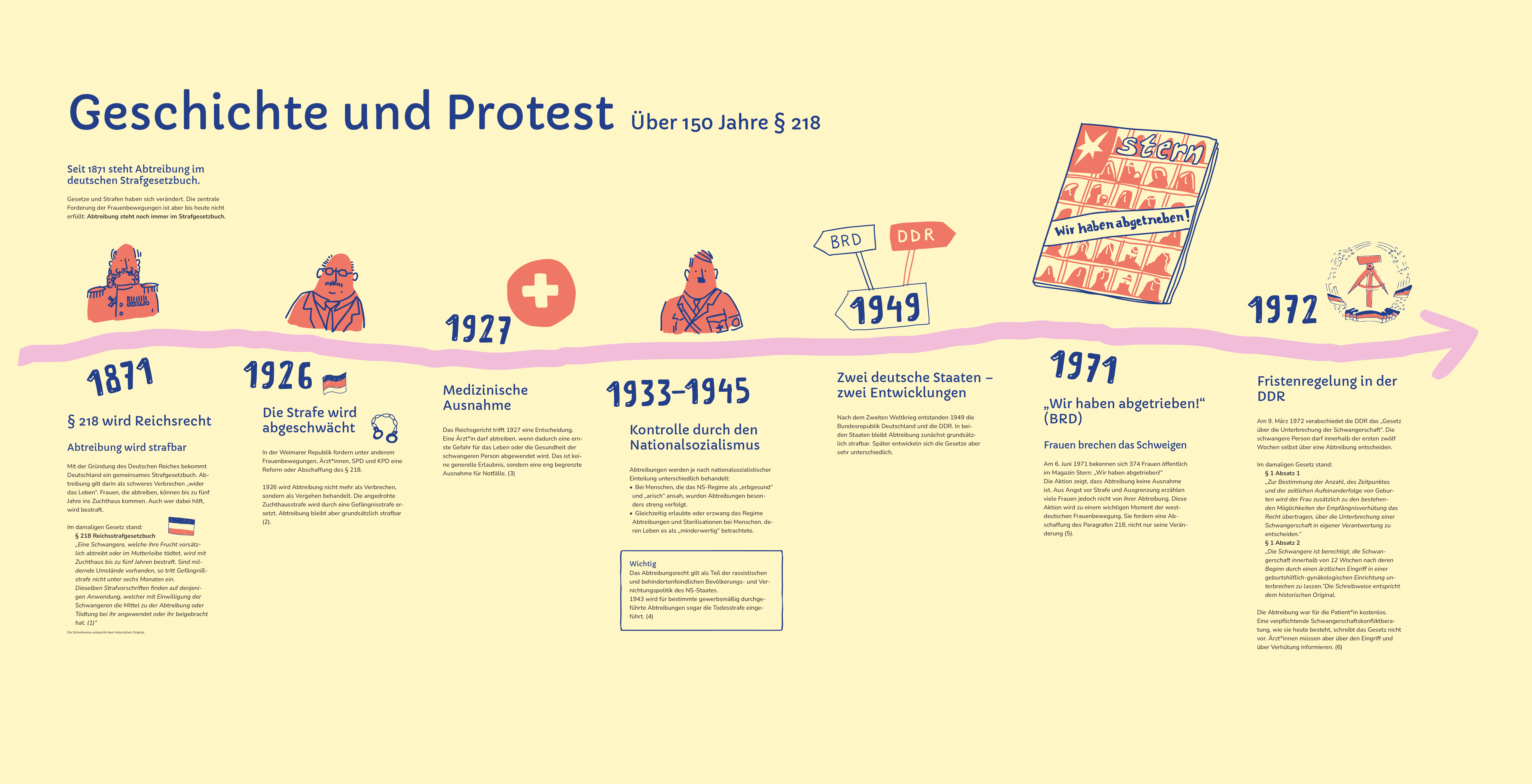
Over 150 Years of §218
Abortion has been part of the German Criminal Code since 1871. Laws and penalties have changed. However, the central demand of the women’s movements has still not been met: Abortion is still part of the Criminal Code.
1871: §218 becomes part of imperial law Abortion becomes a criminal offense With the founding of the German Empire, Germany adopted a unified criminal code. Under this code, abortion was classified as a serious crime “against life.” Women who had abortions could face up to five years in prison. Anyone who assisted in an abortion was also subject to punishment. The law at that time stated: § 218 Reich Penal Code “A pregnant woman who intentionally aborts her fetus or kills it in the womb shall be punished by imprisonment for up to five years. If there are mitigating circumstances, the term of imprisonment shall not be less than six months. The same penal provisions apply to anyone who, with the consent of the pregnant woman, has administered or provided her with the means to induce an abortion or kill the fetus.” (1) The spelling corresponds to the historical original.
1926: The penalty is reduced During the Weimar Republic, women’s movements, doctors, the SPD, and the KPD, among others, called for the reform or abolition of Section 218. In 1926, abortion was no longer treated as a felony but as a misdemeanor. The penalty of hard labor was replaced by a prison sentence. However, abortion remained a criminal offense in principle. (2)
1927: Medical Exception In 1927, the Reich Court issued a ruling. A doctor may perform an abortion if doing so averts a serious danger to the life or health of the pregnant person. This is not a general permission, but a narrowly defined exception for emergencies. (3)
1933–1945: Control by the Nazi Regime Abortions were treated differently depending on the Nazi classification system: Abortions were prosecuted particularly harshly among people whom the Nazi regime considered “genetically sound” and “Aryan.” At the same time, the regime permitted or enforced abortions and sterilizations among people whose lives it considered “inferior.” Important Abortion law is considered part of the Nazi state’s racist and ableist population and extermination policies. In 1943, the death penalty was even introduced for certain abortions performed for commercial purposes. (4)
From 1949 Onward: Two German States—Two Different Paths Following World War II, the Federal Republic of Germany and the GDR were established in 1949. In both states, abortion remained a criminal offense in principle at first. Later, however, the laws evolved very differently.
1971: “We Had an Abortion!” (FRG) Women Break the Silence On June 6, 1971, 374 women publicly declared in „Stern“ magazine: “We had an abortion!” The campaign demonstrates that abortion is not an exception. However, out of fear of punishment and ostracism, many women do not speak about their abortions. This campaign becomes a pivotal moment in the West German women’s movement. They demand the abolition of Paragraph 218, not merely its amendment. (5)
1972: Abortion Laws in the GDR On March 9, 1972, the GDR passed the “Law on the Termination of Pregnancy.” A pregnant person was permitted to decide for themselves whether to have an abortion within the first twelve weeks. The law stated: § 1, Paragraph 1 “To determine the number, timing, and spacing of births, a woman is granted the right—in addition to existing methods of contraception—to decide on her own responsibility whether to terminate a pregnancy.” § 1, Paragraph 2 “The pregnant person is entitled to have the pregnancy terminated within 12 weeks of its onset through a medical procedure at an obstetrics and gynecology facility.”
The abortion was free of charge for the patient. The law does not require mandatory pregnancy conflict counseling, as is the case today. However, physicians must provide information about the procedure and about contraception. (6)
History and Protest
Over 150 Years of §218
Abortion has been part of the German Criminal Code since 1871. Laws and penalties have changed. However, the central demand of the women’s movements has still not been met: Abortion is still part of the Criminal Code.
1974: Abortion Time Limits in the Federal Republic of Germany 1974: Three Days of Freedom (FRG) Women’s movements protest for years, demanding their right to self-determination. On June 18, 1974, a new law goes into effect. Abortion is to be legal during the first three months if counseling is provided beforehand. Three days later, however, the Federal Constitutional Court struck down the law. The CDU/CSU had filed a lawsuit against it.
1975 The Ruling (FRG) On February 25, 1975, the Federal Constitutional Court ruled that the time-limit regulation violated the Basic Law of the Federal Republic of Germany. Unborn life is protected by the Constitution. The protection of unborn life is thus considered more important than the pregnant person’s right to self-determination.
1976 Indications Model (FRG) On May 18, 1976, a new law went into effect in the Federal Republic of Germany: the Indications Model. From this point on, abortion was permitted only if one of four grounds applied: • Medical: Risk to the mother’s health • Criminal: Following rape or incest • Eugenic: A disability in the child • Hardship: A severe psychological or social emergency If none of these grounds apply, abortion remains a criminal offense. Thus, the pregnant person’s own decision is still not sufficient. (7)
1990: Reunification—Two Different Laws Very different regulations applied at the time of German reunification: In the GDR, the time-limit rule was in effect. In the Federal Republic, the indication-based system applied. The Unification Treaty did not initially establish a permanent, unified regulation. The all-German legislature was tasked with finding a new solution. Until then, some differing regulations continued to apply in East and West Germany. (8)
1992: The Bundestag passes a new time-limit regulation In 1992, the Bundestag passed a uniform regulation for all of Germany. In principle, an abortion should not be illegal if performed within the first twelve weeks following a counseling session. A lawsuit was once again filed against the law before the Federal Constitutional Court. (9)
1993: The Federal Constitutional Court Intervenes Again The Federal Constitutional Court ruled that an abortion performed under the counseling regulations cannot be considered lawful. It must be regarded as unlawful under the law, but may remain exempt from criminal punishment under certain conditions. This gave rise to the phrase still used today: Unlawful, but exempt from criminal punishment. The court also required counseling aimed at protecting unborn life. (10)
1995: The current basic rules are established In 1995, the Bundestag passed new regulations based on the 1993 ruling. - Since then, the core provisions have been: - mandatory counseling - counseling certificate - a waiting period of at least three days - abortion performed by a medical professional - no later than twelve weeks after fertilization. These regulations remain in effect in their basic form to this day. (11)
2022: Section 219a was repealed Section 219a of the German Criminal Code (StGB) criminalized the public disclosure of certain information regarding abortions. As a result, doctors could be prosecuted if they publicly stated that they performed abortions. In 2022, Section 219a was repealed. Section 218 remained in effect. (12)
2024: Expert Commission Recommends New Regulations An expert commission appointed by the federal government stated in 2024: Abortions in early pregnancy should be legal. The current provisions in the Criminal Code are untenable for this stage. This was a recommendation. It did not result in any change to the law. (13)
Medical Basics
What methods are available?
Medical method using pills by the 63rd day (end of the 9th week) of pregnancy
How does the medical method work? The medical method involves taking 2 pills. These trigger heavy bleeding. This results in the termination of the pregnancy—that is, the expulsion of the pregnancy tissue and the embryo. Two different pills are used for this, taken 2 days apart. The first pill cuts off the embryo’s blood supply. The second pill triggers strong uterine contractions and bleeding. This often causes nausea, vomiting, and diarrhea. Circulatory problems, headaches, dizziness, and fever or chills may also occur.
Surgical method up to the 98th day (end of the 14th week) of pregnancy
How does the surgical method work? In the surgical method, the pregnancy tissue is suctioned out. The procedure is usually performed under general anesthesia. However, local anesthesia applied to the cervix is also possible.
Counting days/weeks: The duration of pregnancy is counted from the first day of the last menstrual period. Where is a pregnancy termination performed? Pregnancy terminations often take place in hospitals. You can go home after a few hours. Terminations can also be performed in gynecological offices, either surgically or with medication. Sometimes it is also possible to take the pills at home and experience the bleeding there. This is called “home use.” For a home abortion, it’s important to have someone with you.
It is also possible to receive remote support, for example through the “Balance Family Planning Center” in Berlin. This support can be provided online or over the phone. It is provided by doctors. https://www.fpz‒berlin.de/
Good to know: You should have enough pain medication and anti-nausea medication on hand. In rare cases, heavy bleeding may occur. That’s why it’s important to be informed beforehand so you can get help quickly if necessary. In such cases, it may be necessary, for example, to call an ambulance or go to the nearest emergency room. Another surgical method (dilation and curettage*) should no longer be used because it can cause severe damage to the uterus. A follow-up examination can be performed using a special urine test or an ultrasound. You can become pregnant again quickly after a termination. A termination has no effect on future pregnancies. * The term “curettage” dates back to a time when other methods were common. Today, abortions are performed differently. Nevertheless, the term “curettage” persists. It conjures up images of scraping, injury, and violence. Words are not harmless. They shape how we think about abortions. That’s why the terms we use matter.
How much does an abortion cost?
Health insurance will only cover the cost of an abortion under certain conditions, for example, if the pregnancy is the result of rape. If you have a low income, you can apply to your health insurance provider for coverage before the procedure. Otherwise, you must pay for the abortion yourself; it costs between 350 and 800 euros, depending on the method and where it is performed. What are the legal requirements?
The procedure can be performed no earlier than the 4th day after the counseling session. If the pregnant person is under 14 years of age, mandatory counseling and the three-day waiting period are not required, and the costs are covered by health insurance.
What are the risks associated with the two methods?
In general, both procedures are very safe, with rare complications. Rare complications include: the pregnancy continuing, residual pregnancy tissue remaining, inflammation, heavy bleeding, the need for additional surgery, or allergic reactions to the medications used.
International Comparison
Every country has its own rules There is no internationally applicable regulation governing abortions. As a result, the rules vary widely around the world (1). What the WHO Says The World Health Organization (WHO) says: Every person has the right to safe medical care in the event of an abortion. In many countries, this right is not (yet) being upheld. Feminist movements worldwide are calling for the implementation of this right (1). Bans Pose Health Risks Abortions still take place in countries where they are banned. They are performed under poor conditions for the pregnant person. An abortion is then risky. It can pose a health risk to the person involved (1). The easier it is to legally obtain an abortion, the safer it is. Countries with liberal laws: 90 out of 100 abortions are safe. Countries where abortions are banned: 25 out of 100 abortions are safe (3) Europe In most of the EU, doctors are not required to provide a reason for an abortion. The decision of whether or not to have an abortion rests with the pregnant person. This is the case, for example, in Belgium, Bulgaria, Denmark, Germany, Estonia, France, Greece, Ireland, Italy, Croatia, Latvia, Lithuania, Luxembourg, the Netherlands, Austria, Portugal, Romania, Sweden, Slovakia, Slovenia, Spain, the Czech Republic, Hungary, and Cyprus. (1)
Overall, a trend toward more lenient laws can be observed in many European countries. Ireland, for example, still had one of the strictest abortion laws in the world as recently as 2018. (1). Under that law, the embryo was granted the same rights as the pregnant person. After a pregnant person died in 2012 because she had an abortion too late, a referendum was called. However, it is important to note: Even when laws change fundamentally, structural barriers may still exist. This can make it more difficult for pregnant people to obtain abortions. (6)
Setbacks in the EU In some EU countries, access to abortion is becoming increasingly difficult: In Poland, legislation has become much stricter in recent years. Since 2021, abortion has been almost completely banned. Exceptions are possible only in cases of crimes such as “rape or incest.” The decision regarding abortion is made by the treating medical staff. If they violate the law, they face up to three years in prison. (8). Many feminist organizations advocate for self-determined abortion rights. (7). Examples from Asia In Asia, the discussion about abortion often centers on different issues than in Western countries. Here, there is less debate about whether abortion should be permitted or prohibited in principle. Instead, population size plays a key role. For example, if too few children are being born in a country, this can lead to stricter abortion regulations. This was the case in China, for instance. (13) Thus, population size and birth rates influence how strictly abortion is regulated by law. (12,13,14) Russia In Russia, the government is trying to increase the birth rate. This has an impact on abortion laws. More and more private clinics are no longer performing abortions. In some regions, doctors and psychologists are even financially rewarded for dissuading women from having abortions. The Russian Orthodox Church also advocates for stricter regulations, including a ban. (18) Africa In some African countries, abortion laws have become more lenient in recent years. This means that, under certain circumstances, abortions are more easily accessible than before. Nevertheless, strict restrictions remain in place in many countries. Furthermore, the topic of “termination of pregnancy” is still taboo in many parts of the continent. Many people do not speak openly about it. The rules vary greatly from country to country. They range from a complete ban to general permission within certain time limits. Time-limit regulations apply, for example, in Mozambique, Guinea-Bissau, South Africa, and Tunisia. In many countries, an abortion is permitted only if the life or health of the pregnant person is at risk. This is the case, for example, in Tanzania and Uganda. In other countries, such as Ethiopia, Zambia, and Rwanda, social and financial factors also play a role. (14, 16, 17)
United States In the United States, each state sets its own laws. Under Donald Trump, abortion laws were tightened in some states (9). Abortion is strictly prohibited in 14 states. States such as Georgia, South Carolina, and Florida ban abortions after the sixth week. In other states, it is unclear how abortion laws will evolve in the future. As a result, many women with unintended pregnancies face greater difficulties in accessing safe care (14). Studies show an increase in infant mortality. One reason for this is that pregnant women are forced to carry to term severely ill or nonviable fetuses (10). In some states, there is even discussion of criminalizing abortion as murder. Canada In neighboring Canada, however, abortion has been legal since 1988. Most abortions there take place before the 12th week of pregnancy. As a result, Canada has the lowest maternal mortality rate and the fewest post-abortion complications in the world! (11) South America South America has a wide variety of abortion laws. Colombia, for example, has the most permissive abortion laws in Latin America and the Caribbean. There, pregnant people can legally have an abortion up to the 24th week without having to provide a reason. (19) In parts of Mexico as well—such as Mexico City and the states of Oaxaca, Veracruz, and Hidalgo—abortions are permitted within the first 12 weeks of pregnancy. In Argentina, abortion was legalized up to the 14th week of pregnancy in 2020. (14) Nevertheless, there are many countries where abortions are prohibited even in cases of rape or incest. In El Salvador, abortion is completely criminalized and can be punished by up to 8 years in prison. In the event of a miscarriage or stillbirth, women face a prison sentence of up to 30–50 years for “murder.” (14,20). In Brazil, abortions are legal only if the mother’s life is in danger, the fetus has a severe malformation, or the pregnancy resulted from rape. A new draft bill sparked numerous demonstrations in June 2024. The bill proposes that abortions performed after the 22nd week of pregnancy be classified as murder. This would be punishable by six to 20 years in prison—even in cases of rape (14). In Belize, Bolivia, Chile, Costa Rica, Ecuador, Guatemala, Panama, Paraguay, Peru, and Venezuela, abortion is permitted only under certain circumstances—typically when the woman’s health or life is at risk (14).
You can find more information and details about individual countries here: frauenrechte.de
International Efforts for Safe Abortions There are many international movements advocating for safe abortions: The “My Voice, My Choice” campaign (4), for example, advocates for safe access to abortions for women in difficult situations. It received significant attention and was supported by the EU (European Social Fund Plus). With this funding, member states can provide access to safe abortions. However, not every country takes advantage of this support. Each member state decides for itself whether and how people can access a safe and legal abortion. (5)
Barriers to Accessing Abortion
Currently, in order to terminate a pregnancy, certain waiting periods, counseling requirements, medical indications, and other criteria must be met. For example, different regulations apply depending on the stage of pregnancy. (1)
A group of experts (committee) examined the regulations governing abortions in 2024. The committee currently identifies several barriers. It recommends amending the laws to make it easier for people to access safe abortions. It states that abortions in early pregnancy should be decriminalized.
This means that an abortion in the early stages should no longer be treated as a criminal offense. The World Health Organization (WHO) also recommends the complete “decriminalization” of self-determined abortion. (2) Intersectional Perspectives Barriers do not affect everyone in the same way. Some people are affected by multiple forms of discrimination. Various forms of discrimination and life circumstances influence access to abortion. The consideration of these different forms of discrimination is also called an “intersectional perspective.” The question, then, is how different forms of discrimination interact and how they affect people’s lives.
Intersectionality The term “intersectional” originates from Black feminist movements in the U.S. context. It emerged in the 1970s and 1980s. The term stems from a critique of white “mainstream feminism.” It aims to “make visible the intersections of structures of domination such as sexism, racism, classism, queerphobia, and ableism” (1, p. 13). It was coined by the legal scholar Kimberlé W. Crenshaw. (3)
Racism To date, there has been little research on how racism affects access to abortion. However, it is well known that people face racial discrimination within the German healthcare system. Accordingly, it can be assumed that this racial discrimination also affects access to abortion. Those particularly affected may include, for example: Black people, Muslim people, people with refugee backgrounds, Sinti and Romani people, Eastern Europeans, Asians, and Jewish people. (12) In general, people affected by racism face an increased risk of poverty. Whether a person can afford an abortion can therefore be influenced by racist structures. (1)

People with refugee backgrounds People with a history of fleeing their home countries or migration may, for example, have greater difficulty accessing contraceptives and information. Language barriers can also prevent information from being understood at all or lead to misunderstandings. If people live in unsafe or difficult housing conditions after fleeing their home countries, this can influence their decision to have an abortion. People who do not have secure immigration status may face legal and financial difficulties. Out of fear of deportation, many pregnant people pay for the cost of an abortion themselves. This is the only way they can ensure that personal data—such as their address or whereabouts—is not shared with authorities. Such obstacles can lead to unsafe abortions. (0,1)

Anti-Queer Bias In Germany, there are still significant gaps in research on the topic of abortion and queer people. Queer people are rarely recognized as individuals for whom contraception and pregnancy might be relevant. (4) If queer people become pregnant unintentionally, they run the risk of not being taken seriously regarding their identity. Non-binary and trans* people may also feel as though they are being forced to come out. They may experience significant psychological distress. Even healthcare professionals are not always free from prejudice and confusion. (1)
Non-binary and trans* Non-binary people identify outside the binary gender system. This means they do not classify themselves as either completely female or completely male. The term encompasses many different gender identities. Trans* refers to people who do not identify—or do not solely identify—with the gender assigned to them at birth. The gender to which they feel they belong varies widely. This can also be a gender that does not fall within the binary system. The word translates to “beyond” or “on the other side”; it is the counterpart to “cis,” which means “on this side.” Cis refers to people who identify with the gender assigned to them at birth.
Ableism Ableism refers to the discrimination—or devaluation—of people because of a physical or mental impairment or learning difficulties. The term originated in the disability rights movement of the 1980s in the U.S.: the “Disability Rights Movement” (5,6).
Ableism People with disabilities are rarely mentioned in the debate over abortion. They are often denied the right to sexual desire, the desire to have children, and parenthood. (7) Statistically, there is a high rate of sterilization among people with disabilities. (8) There are movements that advocate for the lives of people with disabilities. Nevertheless, life with a disability is still portrayed as difficult or painful.
This plays a major role in abortion decisions: Many prenatal tests check whether the unborn child has certain disabilities or medical conditions. In Germany, about 90% of pregnant people opt for an abortion if trisomy 21 is detected. However, these decisions are not based solely on personal opinions. They are also influenced by societal perceptions and expectations. For example, the notion may arise that the birth of a child with a disability is a “problem” or represents an “unmanageable burden.” (1,9)
Classism Pregnant people affected by classism often find that they are not trusted to handle as much responsibility. For example, they are assumed to be using “poor” contraception and receive less education and counseling. (10) People affected by classism face even greater difficulties in overcoming the barriers to obtaining an abortion. Abortions are not part of basic medical care. The costs must generally be covered by the individual. If a person earns too little, they may be able to have the cost of the abortion covered by their health insurance. This requires organization and time. If a person is uninsured or lacks secure immigration status, additional hurdles arise. A study showed that the decision to have an abortion is not viewed the same way for everyone. Among people with higher levels of education and greater financial means, the decision is accepted. Younger people and those with fewer financial resources, however, are more likely to be accused of acting recklessly. (11) Removing Barriers People should be able to make their own decisions about their bodies and their pregnancies. This requires clear legal guidelines and safe, equitable access to abortion services.
The legal situation should be clarified. If abortions are no longer generally considered a criminal offense, it could also become easier for health insurance plans to cover them. This would reduce the disadvantage faced by people with limited financial means.
At the same time, stigma, prejudice, and discrimination must be eliminated. Medical staff should be educated on these issues. This applies particularly to prejudice against people with limited financial means as well as against queer people. Everyone must have access to understandable information and counseling. This requires, for example, multilingual services, information in plain language, and accessible counseling centers.
Medical care must also be accessible to everyone. This includes accessible abortions, such as those performed with medication. People who do not have a good command of German should receive support through language mediation. (1)